
The Financial Tradeoff of Limping a Dying AC Through the Rest of the Year

The Myth of "Just Making It Through the Summer"
At First Response Heating & Cooling, our technicians frequently hear a persistent myth from homeowners: if you can just force a struggling unit to survive the August back-to-school transition, you are safe until next spring. The financial tradeoff of limping a dying AC through the rest of the year often seems logical on the surface, especially when you are staring down the barrel of a major home decision. You might notice your older unit running constantly, yet the thermostat never quite reaches your target temperature. The air coming from the registers feels cool, but not cold enough to combat the heavy late-summer heat and humidity. This puts you at a critical decision point: authorize another temporary band-aid repair, or invest in a reliable new system.
Before you pour more money into an aging HVAC system, it pays to understand when an air conditioning replacement is actually the more conservative financial move. Hoping a quick fix will get your equipment through the end of the season ignores the harsh reality of the extended Southern cooling season. As our team has seen time and again, every day you force a failing compressor to operate under maximum load, you are compounding the wear and tear on the remaining components. What begins as a strategy to delay a major purchase frequently turns into a cascade of expensive service calls, inflated utility bills, and compromised indoor comfort.
Why the Florida Climate Punishes a Weak AC
The Problem: In many parts of the country, summer heat breaks shortly after Labor Day. In our years of servicing Plant City, FL, we know firsthand that the cooling season extends deep into the fall. An August repair must survive intense heat and high humidity well into November. When you decide to limp a dying unit along, that struggling compressor faces hundreds of hours of additional heavy runtime even after the peak summer weather supposedly passes.
The Cause: Air conditioners do two distinct jobs: they lower the air temperature (sensible cooling) and they remove moisture from the air (latent cooling). As a system ages and its internal components degrade, it loses its ability to perform latent cooling effectively. The evaporator coil may not get cold enough to pull condensation out of the indoor air. The blower motor might struggle to circulate enough volume to keep the air from feeling stagnant. The result is a home that feels sticky, muggy, and deeply uncomfortable, even if the thermostat claims it is seventy-four degrees.
The Solution: Recognizing that the Florida climate demands peak performance for three-quarters of the year changes the math on a late-summer repair. Prolonged poor humidity control does more than just make you sweat; in the homes we inspect, it can lead to secondary issues like warped hardwood floors, peeling paint, and environments where biological growth thrives. A modern, properly sized system effectively manages both temperature and humidity, ensuring your home remains a dry, comfortable sanctuary regardless of how long the cooling season drags on.
The Hidden Costs: Energy Waste and Lost Efficiency
A common question homeowners ask us if your air conditioner suddenly stops working is whether a struggling unit actually uses more electricity before it completely dies. The short answer is yes, and the difference is substantial. As compressors fail, refrigerant lines leak, and coils degrade, the system requires significantly more energy to achieve the same cooling effect. It runs longer cycles, pulls more amperage upon startup, and struggles to satisfy the thermostat.
These inflated monthly utility bills act as a hidden tax of keeping a dying unit alive. You might feel like you are saving money by putting off a replacement, but our technicians often see homeowners actively bleeding funds through their electrical meter. Consider the following hidden financial drains associated with an expiring air conditioner:
• Extended run cycles: A healthy unit cools the house and shuts off. A dying unit runs continuously, drawing maximum power for hours on end just to maintain a baseline temperature against the August late-summer heat and humidity.
• Frequent refrigerant top-offs: Older systems relying on phased-out refrigerants face steep costs for leak repairs and recharges, none of which actually fix the underlying degradation of the equipment.
• Component strain: When one part fails, it forces the rest of the system to work harder. A failing blower motor can cause the evaporator coil to freeze, which in turn can destroy the compressor.
By contrast, modern Energy Star certified systems use substantially less energy to condition the same amount of square footage. Upgrading to high-efficiency equipment creates conceptual monthly savings that help offset the investment. Furthermore, federal tax credits and local utility rebates may apply to qualifying high-efficiency installations, adding another layer of financial incentive to stop throwing good money after bad. We always advise readers to verify current programs with their utility provider or a tax professional.
The Reality of Unpredictable Emergency Breakdowns
Band-aid repairs have a terrible habit of failing at the worst possible moments. Equipment rarely breaks down on a mild Tuesday morning; in our experience, it fails on a weekend afternoon when the system is under maximum load and the outdoor temperatures are peaking. Recently, a local homeowner reached out to the First Response Heating & Cooling team during the late-summer heat with a simple AC problem. Fortunately, our technician was able to help troubleshoot and fix the problem over the phone via FaceTime, getting the system working again quickly. While we love delivering these quick, remote wins, a dying compressor is a completely different story.
When a unit is truly at the end of its lifespan, no amount of over-the-phone troubleshooting will save it. Emergency calls mean waiting for service in an uncomfortably hot home, stressing over immediate repair availability, and making rushed decisions under pressure. The anxiety of wondering if your air conditioner will turn on each afternoon takes a toll on your peace of mind.
Proactive replacement allows you to schedule the work on your own terms. Instead of panicking over a sudden outage, you can research your options, select the ideal equipment for your home, and schedule the installation at your convenience. A new system drastically reduces the frequency of unexpected service calls, meaning you can finally rely on our routine maintenance plan for tune-ups rather than constantly bracing for the next catastrophic failure.
Side-by-Side: Band-Aid Fixes vs. Proactive Upgrades
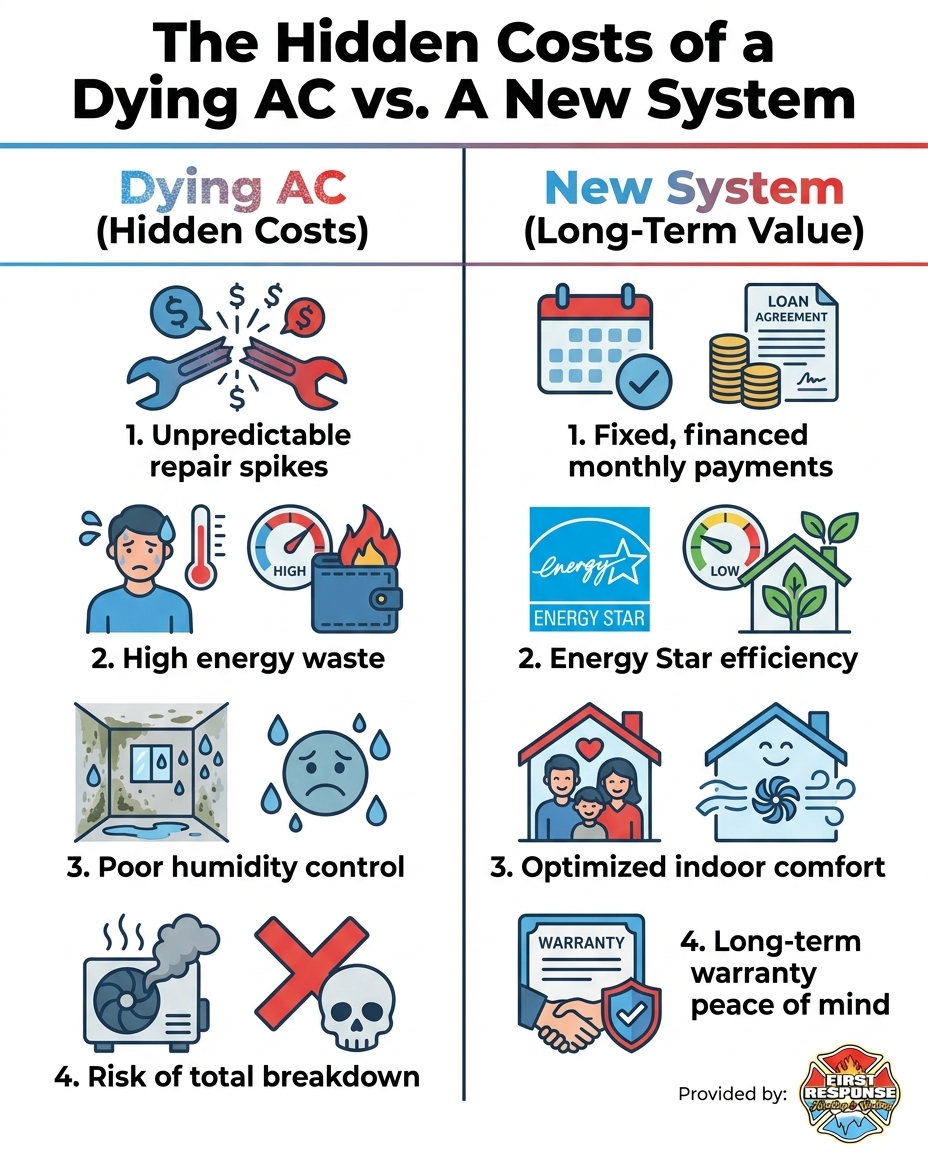
To help you weigh your options definitively, it helps to look at the direct comparison between nursing an old unit and investing in a new one. As industry professionals, we often synthesize these themes using a simple age-versus-repair-cost formula—a conceptual rule where you multiply the age of the equipment by the severity of the repair. If the resulting figure represents a massive chunk of what a new system would cost, replacement is universally the wiser choice. Here is how the two paths stack up against the August late-summer heat and humidity.
• Cost Predictability — Limping a Dying AC (Band-Aid Fix): Highly unpredictable; sudden repair spikes are common as old parts fail. — Proactive System Upgrade: Predictable, fixed monthly payments with no surprise repair bills.
• Energy Consumption — Limping a Dying AC (Band-Aid Fix): High energy waste due to degraded coils and failing compressors. — Proactive System Upgrade: Optimized Energy Star efficiency, lowering monthly utility usage.
• Indoor Comfort — Limping a Dying AC (Band-Aid Fix): Poor humidity control, leading to a muggy, sticky indoor environment. — Proactive System Upgrade: Precise temperature and humidity management for total comfort.
• Peace of Mind — Limping a Dying AC (Band-Aid Fix): Constant risk of total breakdown during peak weekend heat. — Proactive System Upgrade: Long-term manufacturer warranty and reliable daily operation.
When to Repair
Not every malfunction requires a total system overhaul. Our team usually recommends repairing your existing equipment when certain conditions align. If the unit is relatively young and still under its original manufacturer warranty, a repair is usually the right call. Likewise, if the breakdown is a minor, isolated component failure—such as a blown dual-run capacitor or a faulty contactor—replacing that single part will restore full functionality. Finally, if your energy bills have remained stable and the system still effectively dehumidifies your home, a targeted repair can safely extend the life of your equipment.
When to Replace
Conversely, we see the scales tip toward replacement when the unit requires frequent interventions just to survive the season. If indoor humidity is consistently too high and the house feels damp, the system is no longer performing its core duties. When the air conditioner struggles to maintain the thermostat setting during peak heat, running continuously without providing relief, the compressor is likely failing. Replacing the unit before it dies completely saves you from the stress of an emergency outage and immediately stops the financial drain of inflated utility bills.
Overcoming the Upfront Barrier with Smart Options
Our team understands that the biggest reason homeowners in Plant City, FL delay replacement is the fear of a large, unexpected upfront expense. It is entirely normal to feel apprehensive about a major home improvement project, especially when the need arises suddenly in late summer. However, draining your savings on a dying unit is a poor investment. The money spent on a band-aid repair does not add value to your home; it simply resets the clock until the next inevitable breakdown.
Instead of fearing the upfront cost, homeowners can leverage First Response Heating & Cooling's flexible financing options to turn an emergency into a predictable monthly upgrade. Financing removes the immediate financial barrier, allowing you to choose the right system for your home rather than settling for whatever temporary fix you can afford today. This approach grants you access to higher-efficiency models that pay dividends in energy savings over time.
When you utilize smart financing, the math shifts dramatically. You transition from wasting money on old parts for an obsolete system to investing in long-term home value and daily comfort. It makes the replacement process significantly less stressful than enduring repeated emergency service calls.
Make the Smart Choice for Your Long-Term Comfort
Stop letting a failing AC dictate your comfort and drive up your utility bills. Weighing the hidden costs of a band-aid repair against the peace of mind of a new system makes the decision clear. You do not have to settle for a sticky, uncomfortable home in Plant City, FL just because the calendar says it is late summer. Reach out to our First Response Heating & Cooling team to explore your options, review our financing plans, and find a high-efficiency cooling solution that perfectly fits your home's unique needs.
Frequently Asked Questions
When is it no longer worth repairing an AC?
Our technicians advise that it is no longer worth repairing an air conditioner when the cost of the repair approaches a significant percentage of the cost of a new system, especially if the unit is out of warranty. If your equipment requires frequent service calls, uses obsolete refrigerant, or fails to properly dehumidify your home, investing in a replacement is the smarter financial move. Continuing to repair a failing unit only delays the inevitable while inflating your energy bills.
Does a struggling AC use more electricity?
Yes, a struggling air conditioner uses significantly more electricity than a healthy unit. As internal components like the compressor and coils wear down, the system has to run longer cycles and draw more power to achieve the same level of cooling. This loss of efficiency shows up directly on your monthly utility bill as a hidden cost of delaying replacement.
Is it worth fixing a 15-year-old AC?
In most cases, fixing a 15-year-old air conditioner is not recommended unless the repair is exceptionally minor, like replacing a basic fuse. At 15 years old, the system is well past its expected lifespan, likely relies on phased-out refrigerant, and operates at a much lower efficiency than modern standards. Any money spent on major repairs for a unit this old offers a very poor return on investment.
At what age should you replace your air conditioner?
Most air conditioners provide reliable service for 10 to 15 years, depending on maintenance history and local climate conditions. In regions with long, intense cooling seasons, the heavy workload can push a system toward the end of its lifespan closer to the 10-year mark. If your unit is in this age range and experiencing frequent breakdowns, it is time to start planning for a replacement.
How does poor AC performance affect indoor humidity?
An air conditioner removes humidity by passing warm indoor air over a cold evaporator coil, causing moisture to condense and drain away. When an AC performs poorly, the coil may not get cold enough, or the system may short-cycle, preventing it from running long enough to extract moisture. This leaves the indoor air feeling sticky, warm, and muggy, which can eventually lead to secondary issues like warped wood and biological growth.
Can a new AC system really lower my monthly utility bills?
Yes, upgrading to a new, high-efficiency air conditioning system can noticeably lower your monthly utility usage. Modern Energy Star certified units are engineered with advanced compressor technology and better coil designs that require far less electricity to cool the same amount of space. Over time, these conceptual monthly energy savings help offset the initial investment of the new equipment.

Service Areas
