The Burning Smell When You Turn on Your Plant City Heat Pump for the First Time

That First Fall Cold Snap: Is Your Heat Pump Supposed to Smell Like That?
Before the first freeze hits, there's one thing every homeowner should check, but it often comes with an unexpected fright. The burning smell when you turn on your Plant City heat pump for the first time is enough to make anyone rush to the thermostat in a panic. When the first fall cold snap in October finally arrives, you switch your system from cooling to heating, expecting warm, comfortable air. Instead, within minutes, the vents begin blowing out an odor that smells suspiciously like something is on fire inside your walls.
This alarming experience is incredibly common. In fact, at First Response Heating & Cooling, our team receives a surge of urgent calls every autumn from homeowners who are convinced their system is melting down. The immediate decision you face is stressful: do you leave the system running and hope the smell fades, or do you shut it down immediately to prevent a house fire? Understanding how heat pump systems operate during seasonal transitions is the key to making the right call.
In many cases, this distinct burning odor is a completely normal, temporary part of your system's operation. However, knowing the subtle differences between a harmless seasonal quirk and a dangerous electrical emergency is absolutely critical for your family's safety. Let's break down exactly what our technicians see happening inside your air handler and how to read the warning signs.
The 9-Month Dust Buildup: Why Florida Heat Pumps Smell
To understand why your system smells like a campfire, you have to look at how it operates for the rest of the year. Plant City's humid, subtropical climate means that your air conditioner is running almost constantly for roughly nine months out of the year. During this long cooling season, your system is pulling thousands of cubic feet of air through its return vents every single day.
The Role of Auxiliary Heat Strips
Unlike a traditional gas furnace, your heat pump uses electricity to transfer heat from the outside air into your home. However, when temperatures drop sharply, the heat pump needs a little help to keep up with the demand. This is where auxiliary heat strips come in. These are heavy-duty, exposed electrical resistance coils located inside your indoor air handler. They look and function very much like the glowing red coils inside a standard kitchen toaster.
The Anatomy of Florida Dust Accumulation
Because these heat strips are only needed during cold weather, they sit completely dormant from spring through late fall. Even if you change your air filters regularly, microscopic particles of household dust, pet dander, lint, and pollen inevitably slip through and settle on these internal components. In northern climates, these strips are used frequently, so the dust never gets very thick. But in our experience serving Plant City neighborhoods, the heavy, sticky humidity combined with a nine-month cooling season allows a substantial blanket of debris to accumulate.
When that first cold night finally forces the auxiliary heat to kick on, those dusty coils instantly heat up to hundreds of degrees. The accumulated layer of debris is instantly incinerated. This flash-burning of nine months' worth of dust is exactly what causes the intense odor. It is one of the main reasons our dispatchers field so many panic calls about burning dust from heat strips every fall. If the smell is overwhelming, it might also be a sign that you need to explore indoor air quality solutions to reduce the amount of particulate matter circulating through your home.
How Long Is Too Long? The Timeframe for Normal Burn-Off
If the odor coming from your vents is simply the result of incinerated dust, the good news is that it is entirely temporary. However, when your house smells like smoke, every minute feels like an eternity. Having a concrete timeframe in mind can help you assess whether the situation is resolving normally or escalating into a problem.
The 30-Minute Rule of Thumb
Under normal circumstances, our technicians advise that it takes about 20-30 minutes for normal dust burn-off to completely run its course. During the first five to ten minutes, the smell will be at its absolute strongest. After the fifteen-minute mark, you should notice a significant decrease in the intensity of the odor. By the time the system has been running continuously for half an hour, the smell should be virtually undetectable.
Why Short-Cycling Makes the Smell Linger
A pattern we see often is homeowners turning the system off the moment they smell something burning, waiting a few minutes, and then turning it back on. This start-and-stop approach actually prolongs the issue. If you suspect it is just routine dust burn-off, it is best to let the system run continuously so the coils can fully clean themselves and the blower fan can push the residual odor out of the ductwork. If the smell seems to linger for hours after the heat has shut off, it might be time to tell if your air ducts are clogged, as poor airflow can trap stale odors inside the house.
The critical takeaway: If the smell persists beyond 30 minutes of continuous heating, or if it actively gets stronger and more pungent as time goes on, you have moved past normal burn-off and need to take immediate action.
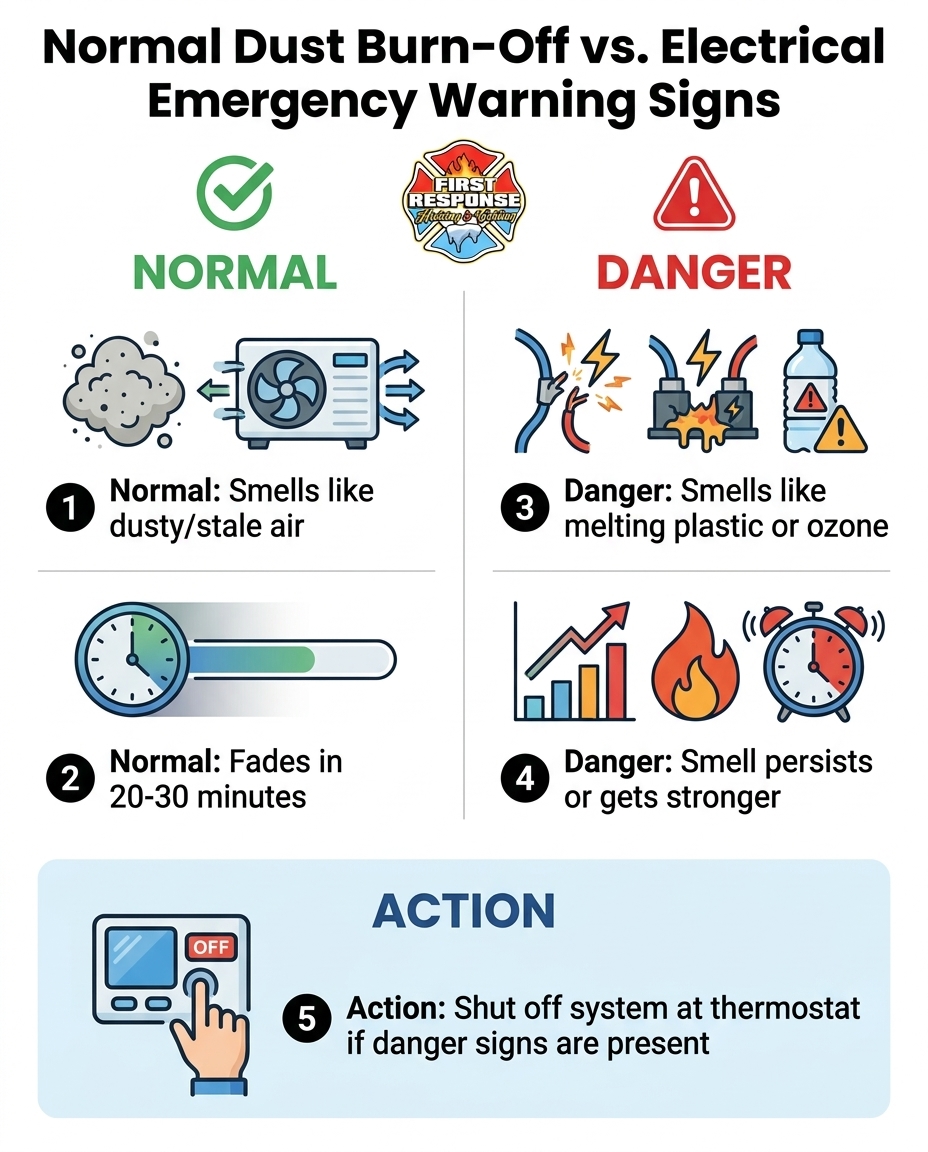
Normal Dust Burn-Off vs. Electrical Emergency: A Quick Diagnostic Guide
When you are staring at your thermostat and wondering if you should call for help, you need clear, actionable criteria. The scent of burning dust is very different from the scent of melting components. Use the guide below, based on what our emergency repair teams encounter, to categorize your situation immediately.
• Type of Odor — Normal Dust Burn-Off: Smells like dusty, stale air, or a hot space heater — Electrical Emergency Warning: Smells like melting plastic, burning rubber, or a sharp chemical/ozone scent
• Duration — Normal Dust Burn-Off: Fades away within 20 to 30 minutes of runtime — Electrical Emergency Warning: Persists indefinitely or grows much stronger over time
• Visual Signs — Normal Dust Burn-Off: None. Just an odor coming from the vents — Electrical Emergency Warning: Visible smoke coming from the vents or the indoor air handler cabinet
• System Behavior — Normal Dust Burn-Off: System heats the home normally and shuts off at set temperature — Electrical Emergency Warning: System trips the circuit breaker, makes loud buzzing noises, or fails to heat
• Required Action — Normal Dust Burn-Off: Allow the system to run until the smell clears — Electrical Emergency Warning: Shut the system off at the thermostat immediately and call a professional
If you are ever in doubt, do not try to guess. We frequently handle panic calls about burning dust from heat strips, and the First Response Heating & Cooling team always prefers that homeowners err on the side of caution. Working with a dedicated local team means you never have to face these scary moments alone. For example, one customer used our Text A Tech service on a busy morning to get help troubleshooting a worrying HVAC issue; our technician Bryan C. was able to provide professional, efficient assistance via text to resolve the problem quickly. Fast, professional troubleshooting is always the safest route to verify if it's a true electrical issue.
What Does an Electrical Fire Smell Like in an HVAC System?
While dust burn-off is harmless, a true electrical fault within your HVAC system is a serious safety hazard. Modern heat pumps operate using high voltage, and when components begin to fail, they emit very specific, unnatural odors that our technicians warn you should never ignore.
The Tell-Tale Scent of Melting Plastic
If the smell coming from your vents reminds you of burning rubber, melting plastic, or a harsh chemical fire, shut the system down immediately. This acrid odor usually indicates that the protective insulation wrapped around the internal wiring is melting due to overheating. It can also point to a failing blower motor that is generating excessive friction and heat. Unlike dust, melting plastic smells toxic and will quickly give you a headache if inhaled in a closed room.
The Ozone Odor of Electrical Arcing
Another major warning sign is the smell of ozone. Ozone has a very distinct, sharp, chlorine-like scent—similar to the air right after a severe lightning storm. In an HVAC system, an ozone smell almost always means that electricity is arcing (jumping) between a loose connection, a failing contactor, or a damaged capacitor. Electrical arcing creates immense heat and is a leading cause of appliance fires.
Why DIY Diagnostics Are Dangerous
If you detect any of these dangerous odors, your first instinct might be to grab a flashlight, open the indoor air handler cabinet, and look for the source of the smoke. Do not do this. HVAC systems contain high-voltage components and large capacitors that store lethal amounts of electrical charge even after the power is turned off at the breaker. General fire safety guidelines dictate that you should never attempt DIY electrical diagnostics on home appliances. Instead, turn the system off at the thermostat, flip the dedicated HVAC circuit breaker to the "off" position, and contact our licensed professionals for heating repair services.
Preventing the Fall Startup Smell Next Year
Once you have survived the initial scare of the first fall cold snap in October and confirmed that your system is operating safely, you might wonder if there is a way to avoid this smelly ordeal entirely. While a tiny bit of dust burn-off is almost inevitable in Florida, our maintenance crews recommend several proactive steps to significantly reduce the intensity of the odor.
Proactive Steps for an Odor-Free Startup
1. Upgrade your summer filter routine: The dust that burns off in October is the dust that bypassed your filter in July. Changing your air filters regularly throughout the long cooling season drastically reduces the total amount of debris that reaches the dormant heat strips.
2. Schedule a pre-season heating inspection: The best time to check your heating system is before you actually need it. A professional technician can inspect the auxiliary heat strips, test the electrical connections, and ensure all safety limit switches are functioning properly before the cold weather arrives.
3. Invest in professional cabinet cleaning: During a comprehensive tune-up, our technicians will carefully clean the interior of the air handler, wiping down the electrical components and removing the heavy buildup of pet dander and lint. This eliminates the primary fuel source for the burning smell.
4. Join a preventative maintenance program: Staying on top of your system's health is easiest when it's automated. Enrolling in a routine maintenance plan ensures your system gets the deep cleaning and safety checks it needs twice a year, keeping it efficient and odor-free.
Proactive care does more than just stop bad smells; it actually extends the lifespan of your auxiliary heat strips by preventing them from overheating beneath a thick blanket of insulating dust.
Frequently Asked Questions About Heat Pump Odors
How long does a heater smell like burning dust?
In our experience, the burning dust smell usually resolves within 20 to 30 minutes for normal dust burn-off of continuous operation. The odor will be most intense during the first ten minutes and will gradually taper off. If your system hasn't been used in over a year, or if you have heavy indoor air pollution (like multiple shedding pets), it may take slightly longer, but it should consistently decrease in intensity over time.
What does an electrical fire smell like in an HVAC system?
An electrical fire smells distinctly of melting plastic, burning rubber, or a sharp, unnatural chemical odor known as ozone. It is an acrid, toxic scent that is very unpleasant to breathe and does not smell like standard, organic household dust. If you smell these chemical odors, you should immediately shut off your system at the thermostat and call for professional service.
Why does my heat pump smell when the auxiliary heat comes on?
Your heat pump smells because the auxiliary heat system uses exposed electrical resistance coils to generate emergency warmth. Throughout the long summer, household dust, lint, and dander settle onto these dormant coils. When the system finally activates the auxiliary heat, those coils instantly glow red-hot, incinerating the accumulated dust and blowing the resulting odor through your vents.
Can a heat pump catch on fire?
While it is rare, electrical malfunctions, severe debris buildup, or failing motors can pose genuine fire risks in any high-voltage appliance. Modern heat pump systems are equipped with multiple safety limit switches designed to shut the unit down if it overheats. However, you should never rely solely on these switches; unusual chemical smells or visible smoke should always trigger a manual shutdown.
Is it normal for a heat pump to smell like it's burning?
Yes, it is perfectly normal for a heat pump to smell like burning dust briefly during its first seasonal use in the fall or winter. However, it is absolutely not normal if the smell happens every single time the heat turns on throughout the winter season. A recurring burning smell indicates an ongoing issue that requires a professional inspection.
Should I open my windows during the first fall startup?
Opening your windows for the first 20 minutes of the initial fall startup is a great way to help ventilate the harmless dust odor out of your living space. Once you notice that the smell has dissipated from the vents, you should close the windows tightly to allow your system to heat the home efficiently without wasting energy.
Get Fast Reassurance for Your Plant City HVAC System
Dealing with strange odors from your vents can be stressful, especially when the temperature is dropping. While a temporary dust burn-off is a normal part of the season, your peace of mind is paramount. At First Response Heating & Cooling, we handle panic calls about burning dust from heat strips every year, and we know how unsettling it can be. If the smell persists, smells like chemicals, or you simply aren't sure if your system is safe to operate, don't take chances. Reach out to our local team of experts today for fast, reliable troubleshooting, so you can enjoy a warm, safe, and comfortable home all season long.

Service Areas
