Why AC Units Commonly Fail in August After Running Fine All Summer

The Late-Summer Tipping Point for Your Cooling System
If you are searching for answers about exactly why AC units commonly fail in August after running fine all summer, you are currently experiencing one of the most frustrating realities of homeownership in a high-heat climate. At First Response Heating & Cooling, our technicians see this exact scenario play out every year. Late-summer August brings a unique kind of stress to your home: an air conditioning system that has operated flawlessly through June and July suddenly freezes up, begins short-cycling, or quits entirely right when the outdoor temperatures are at their most unforgiving.
This sudden breakdown forces a critical decision point for homeowners: trying to understand whether the system is suffering from a minor maintenance issue that can be quickly resolved, or a major component failure that requires immediate professional intervention. The truth is that these late-summer failures are rarely random strokes of bad luck. Instead, our team typically sees that they are the logical result of cumulative mechanical and thermal wear that has been building up silently for months.
When you need to restore your home's comfort, understanding your HVAC systems is the first step toward getting the right air conditioning services to solve the problem permanently.
The 2,500-Hour Toll: Understanding Cumulative Summer Stress
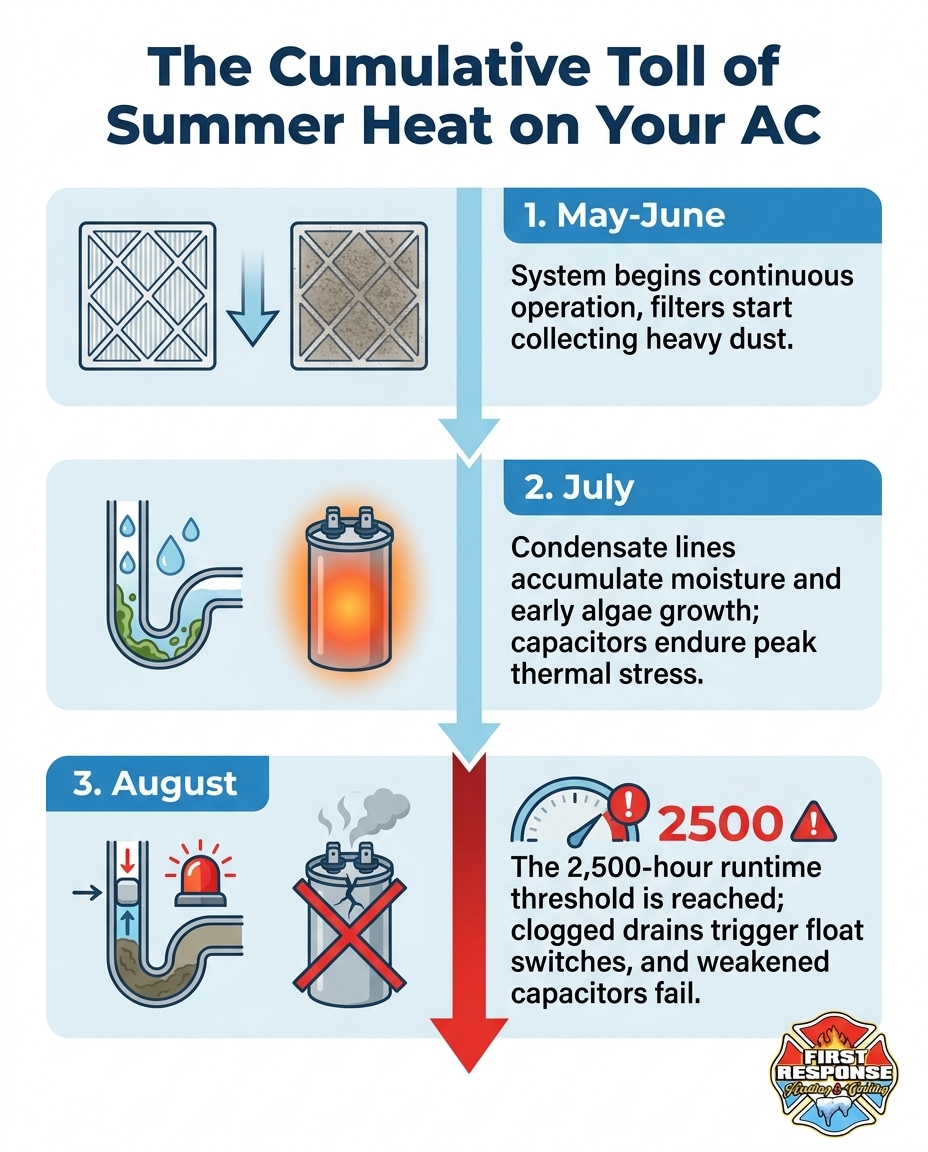
To understand why an air conditioning unit suddenly stops working in late summer, you have to look at a metric known as "hours of runtime." In our experience serving demanding environments like Plant City FL, we see central cooling systems easily log over 2,500 hours of runtime annually. The vast majority of those operational hours are compressed into a grueling window stretching from May through August.
When extreme heat forces units to run almost non-stop, the system is prevented from fully cooling down between cycles. This creates an environment where moving parts, electrical connections, and heat-exchange coils are subjected to relentless, continuous load.
The Invisible Accumulation of Wear
Think of your air conditioner's compressor and fan motors like a vehicle's engine. If you drove a car at highway speeds for 2,500 hours straight, you would expect parts to wear down. The same principle applies to your cooling system. What appears to be a sudden, catastrophic failure is usually the final breaking point of a component that has been slowly degrading under continuous thermal and mechanical stress.
• Gradual Cumulative Failure — Underlying Cause: Months of continuous runtime causing slow degradation of parts. — Typical Late-Summer Symptom: System runs constantly but struggles to lower the indoor temperature.
• Sudden Component Failure — Underlying Cause: Heat fatigue overwhelming an electrical part (like a capacitor). — Typical Late-Summer Symptom: System hums loudly but the fan or compressor refuses to start.
• Safety Shutdown — Underlying Cause: Neglected maintenance triggering an internal safety switch. — Typical Late-Summer Symptom: Thermostat screen goes blank or system shuts off completely to prevent damage.
By the time late-summer August arrives, the system has endured months of this unrelenting operation, making it the prime time for weakened components to finally give out.
Heat Fatigue and Capacitor Failure
One of the most frequent culprits our technicians find behind a sudden late-summer August breakdown is a failed dual run capacitor. A capacitor is a small, cylindrical electrical component that stores energy and delivers a powerful initial jolt of electricity to start your system's compressor and fan motors. Because these motors require significantly more energy to start than they do to keep running, the capacitor acts as a vital electrical booster.
How Heat Degrades Electrical Components
Capacitors are highly sensitive to extreme temperatures. The continuous exposure to high outdoor heat, combined with the internal heat generated by the system running non-stop, slowly degrades the chemical dielectric fluid inside the capacitor. Over months of heavy use, the capacitor loses its ability to hold and deliver a charge. When it finally drops below its required microfarad rating, the connected motors simply cannot start.
• The humming sound: You may hear a distinct buzzing or humming coming from the outdoor unit, indicating the system is trying to start but lacks the electrical push to do so.
• Fan running, no cooling: Sometimes the indoor fan continues to circulate air, but because the outdoor compressor has failed to start, the air blowing from your vents is warm.
• Hard starting: The system shudders violently or dims the house lights slightly when it tries to kick on.
This specific component failure is a common reason for an urgent weekend outage when the system is operating under maximum load. We recently helped a Plant City family on a Sunday afternoon during a severe late-summer heatwave when their AC unit stopped working entirely; one of our technicians was dispatched, arrived within the hour, and quickly identified a failed capacitor, replacing it to successfully restore cooling before the house overheated.
The Humidity Trap: Algae Blooms and Clogged Condensate Lines
In humid subtropical climates, an air conditioner does much more than just lower the temperature; it acts as a massive dehumidifier. Throughout the summer, high humidity forces the system to extract gallons of moisture from the indoor air every single day. This moisture drips off the cold evaporator coil and travels outside through a PVC condensate drain line.
The Anatomy of a Float Switch Shutdown
In our years of servicing systems across Plant City FL, we've seen how the severe humidity from May to August creates a continuous flow of water that acts as the perfect dark, damp breeding ground for algae, mold, and sludge. While the drain line might have been completely clear in May, by the time the back-to-school season hits in August, three months of continuous biological growth can form a thick blockage.
When the drain line clogs, the water has nowhere to go and begins backing up into the drain pan. To prevent this water from overflowing and destroying your ceilings or floors, modern AC units are equipped with a safety device called a float switch. As the water level rises, the float switch trips and instantly cuts power to the thermostat or the entire system.
In these scenarios, the AC stopped working suddenly as a designed safety feature, not because of a mechanical failure. Addressing this requires clearing the biological blockage and exploring indoor air quality solutions that we recommend to help manage moisture and prevent future microbial growth inside your ductwork and air handler.
Severely Impacted Filters and Frozen Evaporator Coils
Basic maintenance often falls by the wayside as the summer drags on, leading to a chain reaction of failures. An air filter that was only slightly dirty in June can become completely impacted by late-summer August due to the sheer volume of air being continuously pulled through the system.
The Chain Reaction of a Frozen Coil
When an air filter becomes severely clogged with dust, pet dander, and debris, it acts like a wall, severely restricting the airflow moving over the indoor evaporator coil. This lack of warm airflow disrupts the heat exchange process.
1. Temperature Drop: Without enough warm air passing over it, the temperature of the evaporator coil drops rapidly below freezing.
2. Ice Formation: The ambient humidity condensing on the coil instantly freezes, eventually encasing the entire component in a solid block of ice.
3. Compressor Overheating: The outdoor compressor continues to pump refrigerant to the indoor unit, but because the coil is frozen, liquid refrigerant can travel backward down the suction line. This forces the compressor to overheat and trip the system's internal thermal safeties.
This compounding issue highlights exactly why our team insists proactive care is mandatory. Enrolling in a routine maintenance plan ensures that filters, coils, and airflow metrics are monitored consistently, preventing a simple dirty filter from causing a catastrophic compressor burnout.
What to Check When Your AC Stops Working Suddenly
When you are faced with a sudden outage in Plant City FL, there are a few actionable, safe troubleshooting steps you can perform before calling our technicians. Sometimes a quick check is all it takes to resolve a minor issue—one of our customers reached out for morning troubleshooting during the late-summer heat, and professional remote assistance via text helped them quickly verify their thermostat settings, resolving the problem without needing a dispatch.
The quick fix checklist:
• Check the thermostat display: A completely blank screen usually indicates a need for new batteries or signifies that a tripped float switch has cut low-voltage power to the device.
• Inspect the air filter: Pull out your return filter. If it is heavily caked with gray dust and debris, replace it immediately to restore critical airflow to the system.
• Check the electrical panel: Look for tripped circuit breakers. If the breaker labeled "AC" or "HVAC" is tripped, you may reset it exactly once to see if the system restores safely.
We draw a clear boundary here: if these basic checks do not resolve the issue, you must stop and seek professional diagnostics. For more detailed guidance on navigating this stressful moment, review what to do if your AC suddenly stops working to ensure you do not inadvertently cause further damage to the equipment.
When to Stop Tinkering and Call a Professional
There is a hard line between safe homeowner troubleshooting and dangerous DIY repairs. Tasks involving high-voltage electricity, such as testing or replacing capacitors, or handling pressurized refrigerant lines, require a licensed professional. Attempting to bypass safety switches or wire components incorrectly can result in severe injury or permanent destruction of the unit.
The Danger of Repeated Resets
If your system's circuit breaker trips a second time after you reset it, do not force it back on. A repeatedly tripping breaker is doing its job: protecting your home from an electrical short or a grounded compressor. Forcing the system to run under these conditions will almost certainly cause permanent compressor damage, turning a manageable repair into a complete system replacement.
When indoor temperatures climb to unsafe levels quickly during a late-summer August heatwave, the urgency of restoring cooling cannot be overstated. Relying on our team at First Response Heating & Cooling means you have access to fast, reliable emergency AC services when you are stranded in the heat. Establishing a relationship with a trusted provider ensures you are never left waiting; for instance, one of our customers who prioritized their yearly maintenance contract renewal during the winter found that staying proactive kept their system running flawlessly when the back-to-school heat arrived.
Frequently Asked Questions About Late-Summer AC Breakdowns
Why did my AC suddenly stop working?
A sudden AC failure is usually caused by a tripped breaker, a blown capacitor, or a clogged condensate drain that has triggered a safety float switch. When the system shuts down instantly rather than slowly losing cooling capacity, it is typically an electrical interruption or a built-in safety mechanism protecting the equipment from further damage. Checking your thermostat for power and inspecting your breaker panel are the best first steps.
What causes an AC capacitor to fail in hot weather?
Prolonged exposure to extreme heat and continuous operation degrades the capacitor's ability to store and release electrical energy. The internal chemical components break down under the severe thermal stress of running non-stop during the summer months. Once the capacitor's microfarad rating drops too low, it can no longer provide the necessary jolt of electricity to start the compressor or fan motors.
Why did my AC stop working suddenly in August?
August represents the peak of cumulative wear; components that have been stressed continuously since May finally reach their mechanical breaking point. Whether it is a condensate line that has finally grown enough algae to clog completely, or a motor that has logged over 2,000 hours of runtime and overheated, late-summer August is the tipping point where neglected maintenance catches up with the system.
How long can an AC run continuously in hot weather?
While central air conditioners are designed to handle heavy loads, running non-stop without cycling off accelerates wear on the compressor and fan motors. On the hottest days of the year, it is normal for a properly sized unit to run for hours at a time to maintain the indoor temperature. However, if it runs for 24 hours straight without ever satisfying the thermostat, it indicates a severe efficiency problem or an undersized system.
Why is my AC running but not cooling?
This is often a sign of a severely dirty air filter, a frozen evaporator coil, or a refrigerant leak preventing proper heat transfer. If the outdoor unit's fan is spinning but the compressor isn't running, a failed dual run capacitor is the most likely culprit. You should turn the system off immediately to prevent compressor damage and call a licensed technician for diagnostics.
Restore Your Comfort Before the Heat Takes Over
Understanding why AC units commonly fail in August after running fine all summer takes the mystery out of sudden breakdowns. An August outage is rarely a random stroke of bad luck; rather, it is the logical result of cumulative summer wear, continuous thermal stress, and high humidity finally overwhelming the system's components. Knowing this helps you make informed decisions about your home's comfort.
A clear, logical explanation of these mechanical realities helps you understand the next best steps for your home in Plant City FL. While you can safely check your filters and thermostat settings, resolving the root cause of cumulative wear requires professional expertise. Don't let a sudden breakdown leave you stranded in unsafe heat. Reach out to our First Response Heating & Cooling team for an expert inspection to accurately diagnose the issue, resolve it safely, and restore reliable cooling to your home.

Service Areas
