Why Your AC Stopped Working Suddenly (And Safe Checks to Try First)

Is Your AC Actually Broken, or Just Losing the Battle Against August Heat?
Late August in Plant City means peak temperatures, and when your system struggles, getting common homeowner questions answered is the first step toward relief. You walk into your living room on a sweltering afternoon, expecting a cool blast of air, only to find the house feels warm, sticky, and stagnant. The air conditioner is running constantly, blowing air through the vents, but the thermostat refuses to drop below 78 degrees. This is the exact moment many homeowners panic, assuming their cooling system has completely failed and a massive repair bill is imminent.
In our years of providing professional air conditioning services across Plant City, our team at First Response Heating & Cooling typically sees a massive spike in these exact panic calls right as the back-to-school season begins.
Before you assume the worst, it is important to understand what your cooling equipment is actually doing. The central decision point you face is figuring out whether this constant running is a sign of normal extreme-heat operation, a dirty evaporator coil that desperately needs maintenance, or a critical failure requiring immediate professional attention. A system running non-stop without reaching your desired set temperature isn't always fully broken, but it is a clear signal that the equipment needs to be evaluated.
The Reality of End-of-Season Cooling
During late August and end-of-season cooling cycles, your air conditioner has already endured months of grueling work. The components are fatigued, the filters have collected substantial dust, and the outdoor condenser has weathered countless severe thunderstorms. When the system runs constantly but struggles to keep the house below 78 degrees during late August afternoons in Plant City, our technicians know it is often a combination of environmental extremes and accumulated wear.
It is perfectly natural to feel frustrated and concerned about the safety and comfort of your family in a hot house. However, jumping straight to the conclusion of a catastrophic failure can cause unnecessary stress. By understanding the physical limitations of residential cooling systems and knowing exactly what safe troubleshooting steps you can take, you can make an informed decision about your next steps.
The 20-Degree Rule: Understanding AC Limits in Extreme Temperatures
One of the most misunderstood aspects of residential cooling is the mechanical limit of the equipment itself. Air conditioners are not magic boxes that can create a 65-degree indoor environment regardless of the outdoor weather. They operate based on strict thermodynamic principles and industry-standard design conditions.
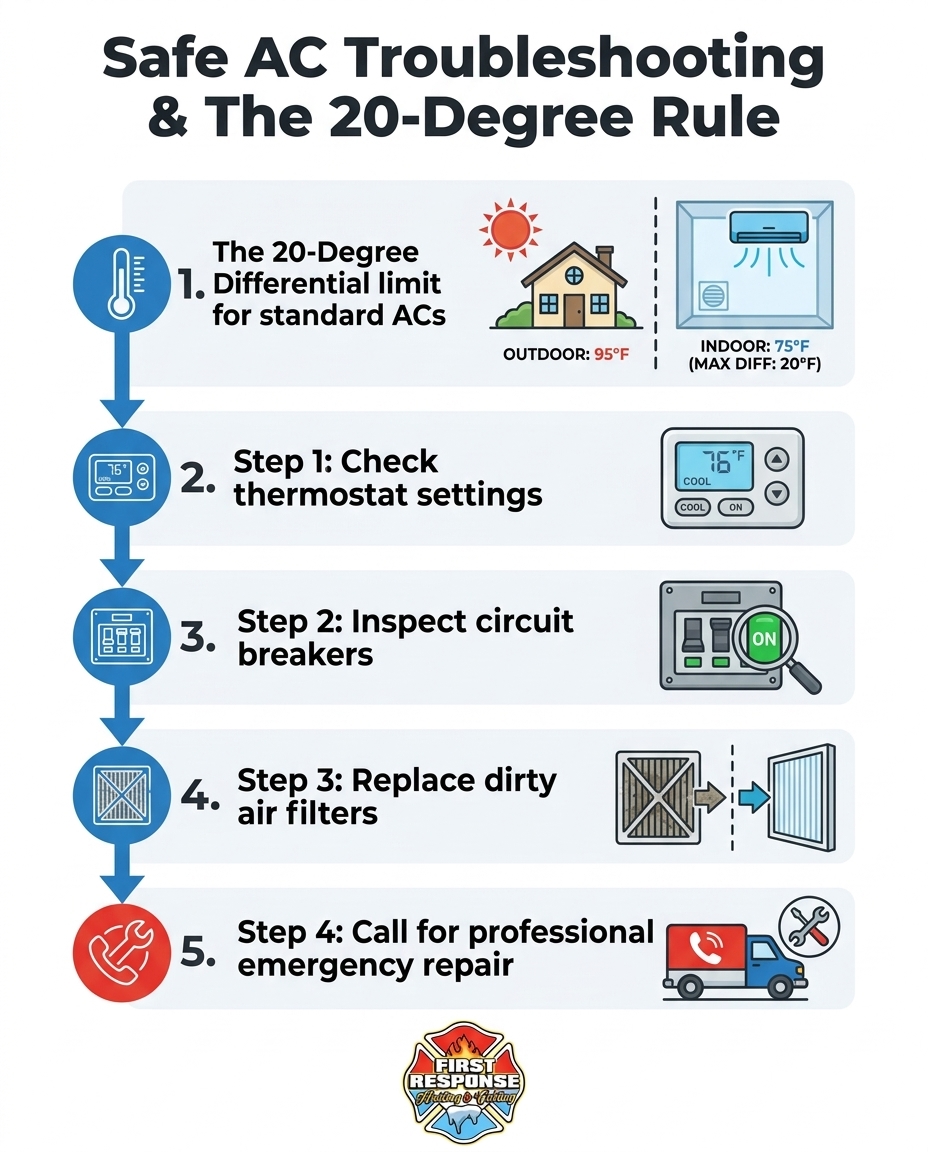
According to the American Society of Heating, Refrigerating and Air-Conditioning Engineers (ASHRAE), standard residential air conditioners are built to cool indoor air approximately 20 degrees below the outdoor temperature. This is known as the 20-degree differential. In the intense Central Florida climate, the local heat index pushes HVAC equipment to its absolute limits on a daily basis. We see this firsthand every August when we explain to customers why their systems can't reach 68 degrees on a 98-degree day.
If you need comprehensive HVAC system repair, understanding these limits helps you communicate effectively with your technician.
How the Differential Impacts Your Comfort
To put this rule into perspective, consider how your system performs as the outdoor temperature climbs throughout a typical late-summer afternoon:
• 85°F — Maximum Expected Indoor Cooling (°F): 65°F — System Status: Operating normally, cycling on and off.
• 90°F — Maximum Expected Indoor Cooling (°F): 70°F — System Status: Working harder, longer cooling cycles.
• 95°F — Maximum Expected Indoor Cooling (°F): 75°F — System Status: Running almost continuously to maintain temperature.
• 98°F+ — Maximum Expected Indoor Cooling (°F): 78°F+ — System Status: Maxed out capacity; cannot safely cool lower.
The critical takeaway: If it is 98 degrees outside, an indoor temperature of 78 degrees means the system is operating at its maximum design capacity. It is not necessarily failing; it is just maxed out. When homeowners push the thermostat down to 70 degrees on a 98-degree day, the system will run continuously, trying to achieve a physical impossibility.
While the system might not be broken in this scenario, continuous operation in these extreme conditions accelerates wear and tear on the compressor and blower motor. Ignoring a system that runs constantly without ever cycling off can eventually lead to actual mechanical breakdowns.
How High Humidity Tricks Your Thermostat (And Your AC)
Temperature is only half of the comfort equation. In Plant City, severe late-summer humidity plays a massive role in how your home feels and how hard your cooling system has to work. Air conditioners serve two distinct functions: they remove heat (sensible cooling) and they remove moisture (latent cooling or dehumidification).
Why Does Dehumidification Happen First?
When warm, humid air is pulled into your return vents, it passes over the cold indoor evaporator coil. Before the air temperature can drop significantly, the system must first condense the water vapor out of the air. The sticky, stagnant air of a Central Florida August forces the AC to expend massive amounts of energy extracting moisture before a noticeable temperature drop can occur.
How Does High Humidity Impact Perceived Comfort?
Human bodies cool themselves through the evaporation of sweat. When the indoor humidity is high—often above 60%—sweat cannot evaporate efficiently. This makes a humid home feel significantly warmer than the thermostat actually reads. You might see 76 degrees on the screen, but it feels like 82 degrees in the living room, leading you to believe the AC has stopped working.
How Should You Monitor Indoor Moisture?
It is highly advisable to monitor your indoor humidity levels alongside the temperature. Many modern smart thermostats have built-in hygrometers. If your indoor humidity remains above 55% while the AC is running continuously, your system is struggling to keep up with the latent heat load. This could be due to an oversized unit short-cycling (though less likely if it runs constantly), a frozen coil, or ductwork pulling in unconditioned attic air.
What to Check When Your AC Stopped Working Suddenly
If your system is running but blowing warm air, or if it has shut down completely, there are a few safe, non-technical troubleshooting steps you can take before calling for emergency service. Knowing exactly what to do if your air conditioner suddenly stops working can save you time and prevent unnecessary panic.
Just recently, during the intense back-to-school heatwave, our First Response team helped a local homeowner who experienced a sudden system malfunction that left their house sweltering. After a prompt service call, we resolved the issue efficiently, saving them from days of extreme discomfort. However, before one of our technicians arrives, you can verify a few basic components.
1. Check the thermostat settings: Verify that the system is set to "cool" and the fan is switched to "auto" rather than "on." If the screen is completely blank, replace the batteries. A dead thermostat cannot signal the equipment to turn on.
2. Inspect the electrical panel: Look for tripped circuit breakers. If the breaker labeled for the AC or HVAC is tripped, you can flip it back to the "on" position. The quick fix rule: Reset a tripped breaker only once. If it trips again immediately, leave it alone to avoid severe electrical hazards.
3. Examine the air filter: A severely clogged filter restricts airflow, which is a leading cause of sudden system failure. Without adequate airflow, the evaporator coils drop below freezing, turning atmospheric condensation into a solid block of ice and halting cooling entirely.
4. Look at the outdoor condenser unit: Ensure the outdoor unit is free of severe debris. Leaves, branches, or overgrown landscaping can block the airflow needed to exhaust heat removed from your home.
A strict safety warning: Never attempt to open electrical panels on the equipment itself, and never handle or attempt to refill refrigerant lines. Air conditioning systems operate on high voltage and contain pressurized chemicals. Handling these components requires professional licensing, and DIY attempts can result in severe injury or death.
Recognizing the Signs of Late-Summer Wear and Tear
There is a vast difference between a system that is struggling against a 100-degree heat index and a system that is actively failing due to late-summer wear and tear. Months of continuous operation naturally degrade system performance. What started as a minor inefficiency in June can easily compound into a major mechanical failure by late August.
In our experience, investing in routine AC maintenance is the most effective way to intercept these compounding issues before they result in a sudden outage.
Common Symptoms of End-of-Season Stress
When an air conditioner has been running constantly for months, specific components begin to show signs of distress. Recognizing these signs early can save you from a complete breakdown:
• Dirty evaporator coils: Even with regular filter changes, microscopic dust bypasses the filter over months of operation, insulating the indoor coil and preventing it from absorbing heat efficiently.
• Strained blower motors: The indoor fan motor works tirelessly to push conditioned air through your ductwork. Over time, bearings can wear out, leading to reduced airflow and overheating.
• Frozen coils: If you notice ice buildup on the indoor coil or the outdoor refrigerant lines, accompanied by warm air blowing from the vents, the system has lost its ability to absorb heat properly. This requires immediate shutdown.
• Failing capacitors: The electrical components that jump-start the compressor and fan motors degrade faster in extreme heat, often leading to a system that hums but refuses to turn on.
Proactive system upkeep is essential to prevent these sudden mid-season outages. A system that is clean, lubricated, and operating with the correct refrigerant charge can handle the late August heat much better than a neglected one.
When DIY Ends: Calling for Emergency HVAC Intervention
While checking filters and thermostat batteries is safe and encouraged, there is a hard boundary where DIY troubleshooting must end. Establishing clear boundaries for safe troubleshooting protects your home, your family, and your equipment.
We recently had a Plant City homeowner reach out during a hot Sunday afternoon when their AC suffered a complete outage. A First Response technician arrived within the hour, diagnosed a complex electrical fault, and fixed it promptly, restoring the home's cooling. This highlights the importance of relying on local HVAC technicians who understand regional climate demands and can respond quickly.
Red Flags That Require Immediate Professional Help
If you observe any of the following symptoms, turn the system off at the thermostat and call for professional intervention immediately:
• Hissing or bubbling noises: These sounds strongly indicate a refrigerant leak. Refrigerant is a controlled substance that must be handled, recovered, and recharged by a certified professional.
• Burning smells: An odor resembling burning plastic or ozone points to a severe electrical issue, such as a melting wire or a failing motor.
• Repeated breaker trips: If the AC breaker trips immediately after being reset, the system is pulling a dangerous amount of amperage, indicating a grounded compressor or a major short circuit.
Attempting complex repairs without proper licensing can instantly void manufacturer warranties and create massive safety hazards. Leveraging the First Response Heating & Cooling approach means you get rapid, reliable emergency intervention and complete peace of mind when the system completely fails, ensuring your home is safe and comfortable without the risks of unlicensed tinkering.
Frequently Asked Questions About Sudden AC Failures
Why is my AC running but not cooling the house?
It could be maxed out by extreme outdoor temperatures, or restricted by a dirty air filter. A clogged filter prevents the system from pulling enough warm air over the indoor coils, drastically reducing cooling capacity. If airflow feels normal but the air coming from the vents is warm, it may indicate a refrigerant leak or a failing compressor that requires professional diagnostics.
Is it normal for my AC to run constantly in extreme heat?
Yes, during peak heat indices, properly sized systems will run almost continuously to maintain the temperature. Because residential systems are designed for a 20-degree differential, extreme heat forces them into non-stop operation. However, if it runs constantly and the indoor temperature continues to rise well above your set point, professional diagnostics are needed to rule out mechanical failure.
What should I do if my AC stops working in extreme heat?
First, check the thermostat batteries, verify the circuit breaker hasn't tripped, and inspect the air filter. These safe DIY steps resolve a surprising number of sudden outages. If these components are normal, turn the system off at the thermostat to prevent further mechanical damage and contact an emergency HVAC technician immediately.
At what outside temperature do air conditioners begin to struggle?
Most systems are designed for a 20-degree differential between indoor and outdoor air. When outdoor temperatures exceed 95 degrees, maintaining a comfortable 75-degree indoor climate becomes highly difficult for standard equipment. The system is not necessarily broken; it is simply operating at the absolute limit of its thermodynamic design.
Can a dirty air filter actually cause my AC to stop working suddenly?
Absolutely. Severe airflow restriction can cause the system's indoor evaporator coils to freeze solid. When the coil turns into a block of ice, it triggers an automatic shutdown in modern systems or completely prevents any cool air from circulating through the ductwork, making it seem like a sudden and catastrophic failure.
Restore Your Home's Comfort with Rapid Professional Help
While some AC issues are simple fixes like replacing a clogged filter or swapping out thermostat batteries, true breakdowns in extreme heat require immediate professional attention. Getting common homeowner questions answered helps you safely navigate the initial panic, but you should never have to suffer in a hot, stagnant house for days on end. If your system is failing to keep up with the Florida heat, schedule an inspection or emergency repair with our team today to ensure your cooling is restored safely and efficiently.


Service Areas
